Showing posts with label Worcestershire. Show all posts

Friday, 16 October 2009

Common Scoters, Bittell

Common Scoters

My Worcestershire list moves on for the third time this month after the earlier great white egret and mandarin ducks. It takes unusual visitors to notch it up and these were sea ducks about as for inland as they could get. A mixture of fifteen females or juveniles treated me to a flying display when I got to the reservoir. Why no males?

I don't know. Much is not known about our only Red-Listed breeding duck except that it may not remain a native breeder. Mink, forestry and oil seem to be the main threats. The species is badly enough off to warrant its own Action Plan. So that's OK, then.

I don't know. Again. How about one great big Action Plan? Something inspired by the observation that “if we keep doing what we do, we'll keep getting what we get”, say.

Now let's talk about me. Or specifically my Bittell list, which has some weird omissions. Today I fixed some of them with little grebe, kestrel, pied wagtail, wigeon and shoveler. So I did well for ducks although I’m still missing teal and pintail, and will probably never add ruddy duck.

It’s been a ducky sort of month so far but it is the time of year when they start to fill our reservoirs, lakes and coastal waters. They're one of the joys of a British winter among... er, not many joys actually. And I’m not getting an escape to Australia like last year’s. (Did I ever mention that?)

Wednesday, 14 October 2009

Redwings & Fieldfares, Upton Warren

Fieldfare

Bang on schedule, these winter thrushes are back. Last year I picked them up a day earlier; but what's a day between reuniting friends? The redwings are already numerous, the fieldfares less so. We saw only one small flock. Skylarks too were on the move. They're not an obvious migrant, being a native breeder, but large numbers fly down from their upland breeding areas and in from the north. Whether this means just Scotland or northern Europe, I don't know.

The fieldfares are an especial thrill with their bold patterns and chattering calls. They also have the coolest nest defence mechanism. Basically, they fly above predators and “shit on the bastards below”. Remember that from football songs of yore?

The two thrushes pushed me closer to my goal of 600 species for the year, as I predicted the winter birds would. The list stands at 578 with a trip to Scotland in the offing at the end of the month. Whooper swan, pink-footed goose, velvet scoter and turnstone should be easy, with maybe red-throated diver, purple sandpiper, crested tit, Scottish crossbill and twite depending on where I go. Locally I could still expect Bewick’s swan, grey partridge, Mediterranean gull, little owl, brambling and that darn bittern, reported on BirdForum, which didn't show again today. I’m also missing barn owl, lesser spotted woodpecker, tree sparrow and corn bunting, but Lord knows whither they've retreated.

What's that? 19 off the top of my head. It sounds easy but, like many birders, I over-estimate. The game is much harder than that.

Monday, 12 October 2009

Impressionist Mandarin Duck

Impressionist Mandarin Duck

Were I sneaky enough, I'd assert that today I dashed this little watercolour off while watching a colony of mandarin ducks on the River Severn at Trimpley, Worcestershire. No-one who reads this blog knows my dismal 9-grade for art O-level aeons ago. However, the picture is the best I can salvage from my Olympus SP-560 stretched to full capability in trying to capture the flock right across the other side of the river. The Severn is wide at Trimpley! The ducks also refused to venture from the very strong shadows cast by the Wyre Forest and a blazing southerly sun.

Alien species seem also to be a Pokerbird theme but these guys are so handsome and apparently innocuous that they're worth a fifty-mile round trip, especially to become my 145th county bird. The list joins Hampshire, my birthplace, on this total, but both still lag Angus on 178. Santa Clara, over in Silicon Valley, beats everything hollow with 219. I know, I know: these figures are not a patch on the real record holders.

On the subject of dismal tallies, the Walkwood Watchers attempt at the Big Sit! yesterday actually bettered some other teams’ scores. Goddammit, we can't even win the wooden spoon!

Sunday, 11 October 2009

Buzzard Brings Down the Curtain on Big Sit!

Buzzard

A raptor would have to figure prominently in a Pokerbird adventure, this time to bring the Walkwood Watchers’ day tally to a meagre 18 and prove my earlier prediction wrong. But what a great 18th bird and so nice to enjoy it without the fear of Maltese bastards gunning it to shreds. Not that they get a chance at our common buzzard; they pick (as though there were anything selective in their slaughter) on the honey buzzard, which isn't even in the same genus despite having a similar name. Buzzard clearly got applied liberally to birds of prey.

The local magpies took exception to it and at one stage four of them were trying to see it off. One persisted much longer than the others and at times I thought I would witness one of those moments photographed recently of the bird riding on the buzzard’s back. It didn't happen.

Nor did the Big Sit really. Unless we pull out a late tawny owl, not heard in these parts for nearly a year, or redwings fly over; and they were reported from the Wyre Forest this morning. The big miss was bullfinch. You expect one or two of those in a day but you also expect compensatory irregulars. We could have had several of woodpecker, nuthatch, goldfinch, starling, marsh tit, lesser black-backed gull, sparrowhawk or pied wagtail without raising eyebrows.

Ah well, here's to next year.

Big Sit! Score Struggles to 17

Chaffinch

A flyover chaffinch has just added to the expected coal tit, jackdaw and jay in the last few hours. The mizzle – it could hardly even be called a drizzle – lasted until mid-afternoon; it doesn't really stop the birds coming in but it does stop the birders going out. A good thing I included four feet of dining room within the circle; this is England after all. At least we could watch the feeders.

The next targets are bullfinch and, strangely, buzzard. I see both every month but that doesn't guarantee every day. And the evening is already beginning to draw in. I’m guessing that, unless we get a last burst of sun, there's no chance of any raptors.

Chiffchaff and great spotted woodpecker bring up the second rank of birds I've seen frequently around Walkwood. Well, chiffchaff informs you I've not endured a winter here. Great spot though is a good candidate for at least being heard. The next two hours will tell.

A Slow Start to the Big Sit!

Jay

Slight drizzle is keeping the bird numbers down from within the Walkwood Watchers’ 17-foot circle. Before I did a quick stint out in the damp just now, only eight species had appeared, among them the usual suspects of blackbird, robin, wood pigeon, dunnock, greenfinch and blue and great tits. Long-tailed tit is never so numerous but they too were on the list.

The last five minutes added magpie, crow, a yaffling green woodpecker, wren and black-headed gulls calling somewhere over Morton Stanley Park. So, we're up to unlucky thirteen. Notable absentees thus far include coal tit, jackdaw and jay, which has been plentiful and obvious, collecting acorns over the last few weeks.

Hopeful of a few of the less regular species, we're still on for around twenty. There's time left to sponsor as well if you’d care to support BirdLife Malta and the RSPB.

Saturday, 10 October 2009

Free Games #1: The Big Sit!

Tomorrow sees the world’s best non-competitive competition, organised by the Bird Watcher's Digest. Basically a team counts all the species of bird seen or heard from within one 17-foot diameter circle. Note that it’s the team not the birds who are restricted to the circle! A flyer (no pun, I’m sure) details the full rules of the challenge.

The Walkwood Watchers, that is Dave (who doesn't know it yet) and I, will probably struggle to get much beyond a count of twenty but is inviting sponsors. I’m in for 50p a species. We'll send the money to BirdLife Malta, whose current home page video is just sickening, and the RSPB. I have to include them: any organisation whose president says “vagina” on the telly has my vote! Good on yer, Kate.

Back to the Big Sit! Anyone out there fancy taking on the might of the Walkwood Watchers? Or at least sponsoring us?

Sunday, 4 October 2009

Great (White) Egret, nr Pershore

Great Egret

Egretta alba according to the Collins Bird Guide; Ardea alba to Wildlife Recorder (WR) and BirdGuides, which includes the “White” in its name. WR only includes “White” for its alternative Egretta alba scientific name. Sibley in the US and Morcombe in Aus both agree on great egret Ardea alba but Robertson & Heather in New Zealand call it white heron Egretta alba. And Robson for South-East Asia throws a complete spanner in the scientific works with Casmerodius albus.

Is this the same bird around the world? To which genus does it belong? Ardea tends to be the herons and Egretta, the egrets. I've had trouble with consolidating worldwide records for this species since I first started seeing it. The confusion seems to be historic and Wikipedia suggests that the egret is in fact a heron, with the possibility that the down-under race is a separate species.

Got that straight? The visitor to Worcestershire showed for all of three seconds this afternoon, less than 1% of the time it took to sort out its taxonomy. Still, the glimpse was long enough to identify black feet, which in the absence of an accurate size is the best distinction from little egret. I was happy enough with it anyway.

Saturday, 3 October 2009

Movie Star at Arrow Valley Park, Redditch

Nuthatch

Not really but, in an odd departure from the factual, my Collins Bird Guide describes the nuthatch as visiting birdtables in worst Rambo style. This is not the first time the Pokerbird has associated a nuthatch with a film. There must be something about the Sittidae family, maybe that Zorro-like mask? Digression apart, today was my first record of our nuthatch at the Valley to bring my score there up to 67. I also logged only my second sighting of tufted duck, which Upton usually delivers for Worcestershire.

Now fully attuned to the phenomenon, I heard one partial burst of a chiffchaff’s song, which is a lot more normal than the full works that have grabbed the country’s attention lately. A grey wagtail broke a five-month drought for what is my favourite species. This is too long and it’s not as though I've been avoiding their habitat: I religiously check streams and ponds for them.

This one obliged by giving me good binocular views and even wagged its way into the same scene as a song thrush, a bird that I totally missed last month. That would have been a great picture if I'd had a camera and 2000mm lens; they were that far away. The sight is lodged in my mind instead, which is what counts really.

Friday, 2 October 2009

The Meaning of the Chiffchaff’s Autumn Song?

Chiffchaff

Fascinating edition of Autumnwatch this evening, if a bit exhausting. Maybe it’s my age (and a considerable amount of Banrock Station). I was at least alert enough to register the bit about chiffchaffs singing. I’ve never been aware of this in the autumn, yet today one was very obvious outside the West Hide at Upton and last week another was calling in Walkwood. Now it seems that others have noticed it too.

What can it all mean?

Mute Swans, Upton Warren

Mute Swans

Seems like they've done well this year, six cygnets all looking a decent, easily defended size. Until recently I laboured under the common misapprehension that the Romans introduced the species into Britain but it appears they merely domesticated the bird. Mute swans are more native than we are. In fact only a handful of species are more alien.

One undoubted stranger graced the Moors Pool this morning too. It looked more ruddy shelduck than anything else but also included touches of red-breasted goose, mallard and Egyptian goose. It would be interesting to see its family tree. These weird hybrids turn up often.

Also regular at Upton, teal, lapwing, Cetti’s warbler (seen!), tufted duck and reed bunting were present. I note them especially just to ensure that they appear in my Worcestershire list. As I left, a couple of swallows dashed across, the latest I've seen them in the county. They must have been hightailing it for the South Coast, where they will hang on, maybe till the end of the month.

No winter returnees yet but it can't be long.

Thursday, 1 October 2009

Great Tits in Walkwood

Great Tit

The only wonder is that I’ve resisted that headline for so long. Actually the coppice was dripping with the birds on my start-the-month-list stroll this morning. Their buzzy, rattling calls and sharp, insistent cheep-cheeps filled the glades. These are just two examples of their vocal repertoire, which some authorities number at 57 – as many varieties as Heinz, which sounds just a little too coincidental. It’s a lot anyway, enough that great tits are probably the source of any unidentified noise in a patch of British woodland.

They're cheerful, cheeky little chappies too, which got me to thinking again about the robin’s autumn song. One hears it and feels it as melancholy but is it really that way round? Pre-music I can imagine early people getting the blues as the year declined, with which the song would have been inextricably linked. Then when we came to making our own music and wanted to express sadness, might that have sounded a bit robin-like? I bet this isn't an original idea.

I know I've banged on about my year list for 2009 but, taking a non-calendar twelve months, the year ending yesterday has been my best ever – 652 species. This isn't a patch on the dedicated listers but I didn't think that I would ever better it. However, my twelve months running up to the end of this October already stands at 649 and it’s missing relatively local birds like bittern, grey partridge, little owl and brambling. I may even hope for jack snipe, lesser spotted woodpecker or corn bunting. Or more.

In any case it’s going to be a good birding month. (It always is.)

Saturday, 26 September 2009

21 Robins A-Singing in Walkwood

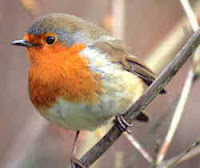
Robin

Doubtless there were more but an hour’s stroll surprised me with this number in such a small Redditch coppice. They were second only to wood pigeons whose abundance was not a surprise. Robins are more obvious at this time of year, being, along with wrens, about the only bird in full cry. It’s all territorial now but even so the song sounds more melancholy than aggressive. There's the pitfall of applying a human interpretation to a wild creature.

Robins also depart from most birds’ behaviour with the female being as adept a singer as the male. She tones it down somewhat in the spring when it is still the bloke’s responsibility to advertise the goods. Now, I’m guessing here because Google has failed me, that the sexes don't have much to do with each other from the autumn onwards. So, each individual bird maintains its own territory, which only breaks down once the spring arrives and love is in the air – la-di-dah.

That's enough romance. I also watched three buzzards soaring. How pleasant to see them without fear of some fascist with a gun blasting them out of the sky. I feel almost shell-shocked from the Maltese slaughter.

Sunday, 6 September 2009

Marsh and Willow Tits

A walk down to Trimpley Reservoir brought my first marsh tit sighting for a couple of months. I was actually on the trail of a willow tit. I thought I heard one but it’s been nearly six years since I even logged one and I’m quite out of touch with its call. It has a nasal, buzzy quality, just like a chickadee, but the marsh tit has a similar, softer call. I got two birds in the binoculars but both were clearly marsh. I’ll have to practise with my Roché bird songs and go again.

The woodland held a wealth of species – great, coal and blue tits, great spotted woodpecker, nuthatch, treecreeper, spotted flycatchers, goldcrest and a raven. That’s certainly flavour of the moment. There was even a train. Ha-ha! The video recorder on my phone works, as does uploading to YouTube – two more landmarks to go with this, my hundredth post.

Saturday, 5 September 2009

Immigration Crisis Over: Swallows Leaving

Swallow

Lord knows what our robins, blackbirds, tits and finches think when waves of hirundines, warblers and swifts sweep into the country from the Third World. Is there an avian equivalent of the BNP? And would the blackbirds be welcome in it anyway? It’s not even as though party leader, Griffon (Vulture), is a native.

OK, that's enough allegory. Or is it metaphor? Upton Warren today saw a stream of swallows, house martins and sand martins pushing their way back to Africa. Hobbies seemed to be following: one perched obligingly by the Moors Pool and darted out for insects. Another laboured over the hide with some unidentifiable feathered victim in its talons.

Birds of prey, in general, appeared to be on the move, too. I saw several buzzards, one of which looked distinctly osprey-like with long, straight, fingered wings. The light was appalling and I was trying to see through trees, so I had to write it off as yet another one that got away. I heard later that a marsh harrier had passed at about that time but I would never have put my bird down as any sort of harrier.

No rarities, then. But some damn fine birds all the same.

Thursday, 3 September 2009

Our Population of Ruddy Ducks

A bit parky at Arrow Valley this morning and, look, the leaves are turning. Brr! I should be heading south again.

The lake held the usual suspects: swans, mallards, great crested grebes, herons, coots, moorhens, greylag geese, Canada geese. So, I got to thinking about ruddy ducks, not that I've ever seen one in Redditch. No, over breakfast I'd read a story in Scribble that opened with ruddy ducks quacking. Had I ever heard a ruddy duck quack? I didn't think so. I'd heard them doing that chest-thumping thang but... quacking?

I checked my Collins Bird Guide which states that they are mainly silent. I thought so. Brownie points for me.

Still I kept thinking about them. Ruddy ducks used to be regular at Upton Warren but my last sighting was over a year ago. I know Defra are shooting them because of their threat to an endangered cousin, the white-headed duck. Doesn't this rather lower the conservation morality to the huntin’-shootin’n’fishin’ level?

It’s one of those dilemmas and, what's more, it begs the question posed by a deeper dilemma. Should we even be removing the duck? The killing fraternity likes to argue from the basic stance of controlling pests, regardless of the method. Pest is one of those words, like weed, that we conveniently apply to what we find inconvenient, like a duck that's outside its known historical range.

Known to us, that is, and in our time frame. Ruddies threaten the white-headed by breeding with them and producing impure offspring. Doesn't this suggest that the two ducks are so close genetically that we may be witnessing speciation in progress? And how many times has speciation been interrupted by outside events pushing the diverging populations back together again?

In a way it hardly matters whether the ruddy ought to be here or not. We've changed the environment so much in the last couple of thousand years that it’s hard to say what should be and what shouldn't. Maybe we should examine our relationship with the word “should”.

So, philosophically, should I head south?

Tuesday, 1 September 2009

Raven, Redditch

Raven

First of the month, so my rather irregular jaunt round the coppice at Walkwood to get the September list going. Well, last month I was on my voluntary job in Cornwall; in July on an outing with the RSPB at Cannock Chase; June dipping on purple heron at RSPB Saltholme... Dave and I hadn’t gone far into the wood when a loud cronk issued from the canopy.

So, out on the moors, up a bleak hill or on some storm-lashed cliffs, raven would have come to mind immediately. But in Redditch? I caught a black shape flap noisily away above us. It was indisputably a raven.

The call took me back a few days to walking back from Tesco, a route through suburban Redditch, when I also heard a single cronk. I looked up then, saw nothing and dismissed it as a figment but now realise that it too must have come from a raven. The species does seem to be spreading. I see it regularly at Bittell and reports appear on BirdForum from Upton Warren, so I can't be long adding it to that list.

There's no reason, apart from persecution, why these “honorary raptors” shouldn't spread. I used to see them regularly in the Bay Area where, like golden eagles and harriers, they thrive in the absence of gamekeepers. Funny that, ain’t it?

Thursday, 27 August 2009

Black Terns, Upton Warren

Upton Warren

An influx of these through the Midlands in the bad weather yesterday left three over the Moors Pool this morning. Without expecting them, they're easy to overlook initially. The adults have largely moulted into winter garb, which along with the juveniles’ plumage, renders them white below and only somewhat greyer above than common terns.

Their behaviour gives them away. Their constant, bouncy flight brackets swift plunges to the water’s surface to pick off insects. Closer inspection, even just through binoculars, reveals the darker shade, a hint of collar and, on the youngsters, a definite leading dark band to the wings. For contrast a common tern did join them later and was clearly bigger and sturdier too.

Despite missing the late spring’s black terns in breeding plumage, it was good to add these to the year list and moreover to my score from September last year, which now stands at 645. I used that date as the start point for my round-the-world twelve-month list but may push it back to October because I’m off to Malta in a couple of weeks. More of that later, I’m sure.

I spent an hour in the lapwing (east) hide, absorbing these birds plus a very obliging common sandpiper and male kingfisher. I know this now because it wasn't wearing “lippy”, as someone put it (the female has a red base to its bill).

Saturday, 22 August 2009

Sabine’s Gull, Upton Warren

Sabine’s Gull

My good friend, Midlands Birder, was at the twitch for tonight’s flight in of this handsome arctic breeder. It must be a little way off its course from Greenland or Canada to Africa: some birds skim our western shores but rarely reach as far inland as Worcestershire. I was lucky enough to pick it out as it flew and so got the full benefit of its striking black, white and grey wing pattern.

It’s a beautiful thing. And British bird number 277 for me.

Monday, 17 August 2009

Cormorant, Redditch

Cormorant

Not exactly a headline grabbing species but in more than ten years association with the place, including living in it for several months and twenty-four visits to Arrow Valley Park, I have never seen a cormorant here. The Park it was that held one today and therein may be a clue: it is a fishing park. The angling community’s main take on cormorants is to kill them. Google “cormorant angling” and check out what comes back to get a flavour. Even the BBC calls the birds “greedy and vicious”, exclusively human traits, I would have said.

I don't take that crap about minorities giving the majority a bad name on board either. Fishing to eat I can understand. Fishing to haul some hapless creature out of its natural environment and asphyxiate, I don't get. Even catch and release hardly seems a pleasant way to behave towards a creature. Imagine if birdwatching were like that!

The idea of at the very least hurting something must surely be ingrained in the psyche of hunters. Not much chance they'll think outside that particular box for any obstacle to their gratification, like a cormorant. Really, their parents should have drummed the spoilt two-year-old out of their systems.

 
Creative Commons License

This work by Andy Gibb is licensed under a Creative Commons Attribution-Non-Commercial-Share Alike 2.0 UK: England & Wales License. It also uses Google Analytics and so creates tracking cookies and collects non-identifiable data about you.