Pokerbird has moved to http://blog.theandygibb.com/
Showing posts with label world travel. Show all posts
Showing posts with label world travel. Show all posts
Sunday, 16 January 2011


Tuesday, 13 October 2009
Australian Roads & Shopping

You know those roadside warning signs? Low-flying aircraft. Slippery when wet. Old people – always bent double; I’m not going to be like that, surely? Wild animals. And in Australia, kangaroos. They get their own special sign. And you know how you ignore them because the hazards never happen?
A mistake for the first one I passed on my way to Armadale from Perth. Just minutes after it, a large ‘roo bounded across the road in front of the car. No worries yet. The animal was far enough ahead and gone quickly enough that it presented no danger but the nether regions of my mind were firing synapses. I was on the brake pedal and checking for tailgaters without a conscious thought. “They travel in pairs,” I had read.
Sure enough, a second, smaller creature appeared under my left bumper. I had time and space to swerve and the animal must have sensed me too, because when I looked behind, the road was clear. No squished carcass. No thud either. No damage to the car. That would have been a good start to the trip.
Aware of the inverse irony of the situation, I drove more slowly that day, that week and for the bulk of the holiday, all the way from Adelaide to Cairns. It was truly ironic, then, that not a single other kangaroo road-hopped in all that time.
I stopped at Armadale, which seemed basically to be a shopping centre, as unremarkable as Redditch. Except that Redditch folk don't shop in bare feet. Nor does everyone in Armadale and at first I thought I was seeing some grossly underprivileged section of Australian society. It was weird and a little unnerving. Didn't these people even worry about broken glass or dog shit? But that was me being particularly British. Australia is relatively litter-free. The roadsides, for instance, are pristine compared with our corpse- and McDonald’s-strewn motorways. Down under, you only have to watch for the wildlife. ⇐ ⇒
Friday, 25 September 2009
Why Not Gun Down the Gunmen?
After witnessing Malta’s war on birds, it is tempting to fight fire with fire: go into the shooters’ lairs and massacre the lot of ‘em. Take out their children and wives too, and by implication all succeeding generations. That would solve the problem, wouldn’t it? In the same vein I've listened to birders here talk of shooting dogs that run amok through flocks of birds, and driving over cats for being... well, being cats.
In a rational moment anyone could predict that these actions would escalate the problem. It is how wars get going. It’s interesting though to dissect why such a notion is tempting.
Number one has to be the motivation of being right where the other guy is so clearly wrong. We all love that and go out of our way to find ever more issues in which to put one over. There's nothing like the feeling of being right. From that standpoint we can totally invalidate the opposition and justify whatever action we take.
There is a problem. Right and wrong don't exist. You can't point at them. They have no weight. We invented the words without, unfortunately, a precise definition or field guide to aid in identifying them. By their tenuous nature right and wrong have become a barrier between people; we no longer connect across the words and neither side gets what it wants.
What's the solution?
We're bad at this. Thousands of years of disputes have come down to the same old answers: have a war; write a law; kill ‘em; bang ‘em up; boycott their goods; fine them; and so on. Each creates a new problem, sometimes a worse one, without even necessarily solving the old. Maybe, as a society we're simply not mature enough yet to be successful at handling problems. Maybe we need to recognise that they will always exist and we don't need to solve them, just turn them into problems we’d like to have.
Here's a nice one, inspired by a couple of incidents from my week on Malta.
On my one day off I caught the bus to Rabat from Dingli, where I waited at the stop with a couple of lads. I asked one when the bus was likely to turn up.
“It’s a bus,” he replied, showing that the universal experience of buses was at least one shared piece of humanity.
We went on to talk in the usual male lingua franca – football. He was a Pompey fan; I’m Saints – the biggest clash of right and wrong on the South Coast. But we connected and no-one came to blows and no birds got shot. He even spent the journey into Rabat pointing out his favourite landmarks.
The second scenario saw me throw an errant football back to a kid in Buskett Gardens. He very politely thanked me in perfect English before continuing his game.
No, I’m not suggesting football as a better problem, although it could have its part to play. But kids, yes. I doubt that either of these two nippers would be interested in blasting bundles of defenceless feathers out of the sky. In fact, wouldn’t a child be horrified by it? I mean actually seeing it and the bloody, broken mess that is the end result? I don't mean as some hypothetical, virtual computer game.
Wouldn’t a child be more in thrall to the beauty of a wild creature? Wouldn’t it be worth capturing that spirit before the murderous adult world begins to impose its twisted values? Win the hearts and minds of the youngsters and they will surely swamp their butchering parents. Then the next ten years will just be a damage limitation exercise.
Monday, 21 September 2009
Pulborough Beats Mizieb Any Day
What a contrast. This morning I enjoyed wood sandpiper, black-tailed godwit, green sandpipers and even an alien species, Egyptian goose, in the English peace of RSPB Pulborough Brooks. A sparrowhawk circled and climbed, and a kestrel flapped low over the wader scrapes. I didn't have to fear for them.
One week ago at the battlefield of Mizieb in Malta, almost certain death would have visited the two birds of prey. As it was, those woods were silent and empty, save for a handful of hostile gunners, looking like mama had just taken their favourite dolly from them. We also walked past a veritable ghetto of crudely constructed shooting hides. I had the impression of passing through a deserted concentration camp, but one that was ready to jackboot to attention in a moment.
Over-dramatic? Not given the latest grisly evidence from Malta’s war on birds. Just yesterday at Mizieb, BirdLife and CABS recovered 76 freshly killed birds supposedly protected from the shooters by the Maltese government. If you think our politicians are cynical, that lot are positively brazen. I don't know how the Maltese can bear them any longer.
Saturday, 19 September 2009
The Only Casualties in this War
What you won't see in any travel brochure: “Watch magnificent birds of prey that have flown the length of Europe blasted out of the sky. See those that only have their legs blown away die slowly from being unable to land. Marvel at the rubbish-strewn, lunar landscape, stripped of vegetation by bird-trappers. Endure the dark, hostile scowls of the locals.”
Outside the thin veneer that is Valletta. Mdina and the tourist resorts, this describes a week in Malta.
And what about this side-note? Planes from Britain, the Emirates, Egypt, Spain and other Western nations land just yards from gun-toting hunters. Doesn't this seem crazy? Who can tell the difference between them and Al-Qaeda operatives? The latter could position a whole arsenal by the airport without raising a single eyebrow. Imagine allowing that at Heathrow.
The raptor slaughter is but a pinprick in the hundreds and thousands of other birds who also fall prey to hunters’ guns and traps. Want to see a finch on the island? Go look in a cage. Go look in a British cage. Seriously, you’re more likely see one there.
The finches are more of a local problem. The international scandal is that Europe now invests time, space and money for migrant birds to come and breed in safety. They're our birds, born in our lands. We don't want them gunned down by Mediterranean savages, never to return again. In any other war – and this is a war, declared against birds by Maltese hunters and ruthlessly promoted by them – we would send the army to protect our citizens. As it is, a few dozen brave, dedicated birdwatchers from all over the continent can really only monitor the situation, as helpless as UN observers.
In case the Maltese government hadn’t noticed, the environment is top bill these days, right up there with terrorism. Birds are the environment, in fact one of its best gauges. To slaughter them on such an industrial scale must be the biggest act of vandalism in Europe. It’s time for the country to drag itself into the 20th century. Only then should we even consider allowing them to participate in the 21st century Union.
Friday, 18 September 2009
On Flying Away from Malta

It's been a strange raptor-watching holiday when you've been urging the birds to "Just go. Fly away. It's not safe here." This picture shows, if you can pick them out, a few of the killers' hides, dotting the departure coast of Malta. The gunners will even shoot birds down over the sea, which gives the lie to any claim of hunting for food.
Wednesday, 16 September 2009
Death in the Afternoon
Yesterday saw the start of the 3 o'clock hunting ban, so we enjoyed peace at the Mtahleb killing fields. So did a flock of bee-eaters, without fear of their gorgeous plumage being ripped to shreds by assassins' shot. Even a much later young honey buzzard seemed safe and we admired cracking views as it sought evening refuge. It had almost dropped over the horizon when it appeared to stoop. A second later, "crack, crack, crack" told a different story.
We were struck dumb. The first flouting of the law in hours and some cunt had slaughtered yet another of our birds.
Malta has decades yet to go to catch up with the 21st century.
Monday, 14 September 2009
A Maltese Attitude to Hunting
Sunday afternoon our raptor-surveying team met a plane-spotter at the airport and heard a normal Maltese's reaction to the gun-toting hooligans. He and several friends had watched a "large bird" fusilladed down at their watchpoint. "Grown men, we wanted to cry," he said. Everywhere the teams go, the same message from the majority but too intimidated by the bully boys. That's why we're here.
Sunday, 13 September 2009
Hunting Birds on Malta
You can do it with binoculars or guns. Sadly, guns are more prominent, especially this morning when rain promises to bring birds in. A nice welcome for them. Again, a minority makes life a misery for everyone else. It seems that the Maltese are scared out of their own backyard by the gun louts. How often does this pattern repeat itself?
Saturday, 12 September 2009
Malta Ain't So Rustic

There's a little bit of postbox England in Malta, right outside the hotel. Last night I also passed belisha beacons, which seem to have disappeared back home. Things are rural round here but it took miles of urban getting away from the airport - not what I expected.
Friday, 21 August 2009
2008: Whither from Perth?
The last Saturday of November and the sun was blazing. I had a car and Western Australia was at my feet. There was to be no pelagic but my Bransbury suggested other bird-rich sites near Perth – Rottnest Island and Yanchep National Park among them but both in the wrong direction for Stirling Ranges, which was a recommendation I had to see. Unhappily, he listed nothing on the way, a distance of about two hundred miles south-east. I seemed to be in for some solid driving.
First, though, I required better accommodation than the backpackers for my return and last couple of nights in town before flying to Adelaide. To this end I ventured out to Guildford in the eastern suburbs. I don't know: I must have thought it would be quieter and have cheaper hotels. It was also on a railway line for easy access to downtown and close to the airport for an early morning departure.
I was wrong about the hotels. What few Guildford had were way expensive. Instead I settled for a full Australian breakfast, rather similar to the sort I could have eaten in Surrey, while Frank Sinatra crooned over the café’s music system. Winter heat, brekky, ole blue eyes: life doesn't get much better.
The route south took me round the airport, so I scouted the neighbourhood for lodgings and found the old reliable standby of Formule 1. That would do; I'd book it when I had Web access. For the time the Tonkin Highway was removing me from metropolitan Perth and into paperbark groves. I wasn't sorry to leave: the city hadn’t lived up to glowing reports and assurances that, “I'd love it.” It had been pretty ordinary.
Wilder, more untamed regions beckoned. I got a much faster taste of how wild and untamed barely ten miles from the city centre. ⇐ ⇒
Saturday, 15 August 2009
The Australian Nature Reserve: Whingeing Pom #2
If my previous whinge was about one particular backpackers, this rant does include a more general anti-Australian sentiment. However, it is anti-anywhere outside Britain because we’re such the world leader that the rest of the planet looks totally shite. Heavens! What could it possibly be? You’ve read the title, so you know already. It was never going to be our ethnic cuisine or weather or drinking habits, was it?
Yup, nature reserves, or more specifically facilities for watching wildlife. Australia is blessed with a great many conservation parks and so on, and probably beats us in terms of percentage of land set aside for nature. This sounds good for the birdies and critters, but is it? If the public can't engage with all this space, won't they eventually resent accommodating it? Won’t it suffer abuse, being out of sight, out of mind?
The Herdsman Lake Visitor Centre was the last useful, enclosed birding facility I would find until Atherton, by which point I'd driven ten thousand kilometres. This journey did throw up the odd shelter and a couple of hides that looked over dried-up lakes, but that was it. The antipodean birding Mecca of O’Reilly’s in Queensland had no more than a café balcony from which to view. Even low-cost basics like information boards were missing and as for more substantial infrastructure like car parking, visitor centres, cafes, shops, accommodation... patchy in the extreme.
Imagine travelling six thousand miles in Britain or about seven times between John O’Groats and Land’s End. You could use that distance to zigzag liberally down the country through major centres like RSPB Forsinard, Loch Garten, Strathbeg, Montrose, Vane Farm, Lochwinnoch, WWT Caerlaverock, Saltholme, Leighton Moss, Martin Mere, Welney, Titchwell, Cley, Minsmere, Barnes, Dungeness, Pulborough, Arundel, Radipole, Slimbridge, Sedgemoor, but strangely not into Devon and Cornwall. This is only a selection and then there are countless smaller reserves, Wildlife Trust sites, even individual, unaffiliated hides. I know we're a compact little island but you don't have to travel far to watch birds in comfort.
The only upside to the paucity in Australia was that I felt like quite the pioneer, a frontiersman, opening up new territories, boldly going where no birder had been before. It was more of an adventure. And I bloody well earned the birds I did see.
Not so much a whinge then, as a hymn of praise to Britain. We're crap at just about everything else but we do birding good. Maybe we don't take so much care of the actual birds themselves but that’s a whole other rant. ⇐ ⇒
Saturday, 27 June 2009
A Perth Rant, 2008: Whinging Pom #1
I don't know what thoughts occupy some people’s heads. Precious few in the case of the wankers staying at One World Backpackers at the end of November. Even if they didn't know the place had paper-thin walls and echoed like an underpass, there's little excuse for shouted exchanges until four in the morning. Not even on a Saturday and far less mid-week.
I endured three nights of it. The hostel had a no-money back policy and I'd paid up front. I wasn't about to complain. I've lived long enough to experience that futility. There was little the hostel could do anyway and as for tackling the perpetrators... well, even if drink hadn’t addled their senses, their obvious fuck-you attitude would have guaranteed an escalation of the problem. I had been victim of that on my departure from Edinburgh and had no wish to retry it.
I resolved to avoid hostels and pretty much kept to it. (The breakfast was shite too and they overcharged me.)
I had only lost one night’s sleep and scavenged what I could for one breakfast when I headed for the Botanic Gardens the first morning, so I wasn't feeling too shabby. The parrots of the night before were still in evidence and still naggingly familiar. I got a few field marks – surprisingly difficult for parrots – and launched into my Simpson & Day to nail an identification. ⇐ ⇒
Sunday, 21 June 2009
Arrival at Perth, 2008
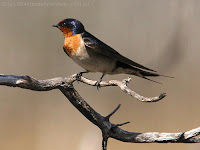
Red.
That's the impression of Western Australia from the air, the very ground rusting away, contrasting with the Indian Ocean blue as our plane followed the coast down to Perth. Not a town to be seen for hundreds of kilometres until the grids of civilisation appeared within a boomerang-throw of the capital. Perth almost sneaks up on you in surprise and we were down and out of the terminal faster than Adam Gilchrist gets to a century.
I had booked the shuttle bus downtown, which rather surprised the driver, who was prepared to hang around until the last passenger had squeezed out of the airport. This gave me time to identify welcome swallows, so at least the birds were pleased to see me; and I had finally hit summer after a couple of dismal British washouts.
The bus bounced into the city, over the Swan River, home to silver gulls, and past the WACA, home to cricketers. The kid sitting in front of me clicked his camera phone at everything. He had flown from Britain in one and was hyper from lack of sleep. He snapped the cricket ground. He had no idea what it was – cute.
The remainder of the day only gave me time to eat but it was light enough, while I sought out a restaurant, to register parrots squawking and zipping between trees. They were too fast to identify but the calls were familiar; I just couldn't pin them down. A disappointing nasi goring preceded bed, perchance to sleep. Or not, as it happened. ⇐ ⇒
Thursday, 18 June 2009
2008: The Leaving of Singapore

After my exertions I was pleased to sit, along with the other small boys, at the driverless front of the wee train gliding above Singapore’s suburbs. I then caught the LRT’s North-South line wrong way round back to Orchard Road and passed the more industrial sector of the city but even that looked clean and tidy. After Yishun the railway crossed the Lower Seletar Reservoir, complete with egrets and diverse waterfowl. I was too knackered to investigate.
The main shopping street was pretty much the same as Barcelona, Cannes, London, even Edinburgh, and I didn't dwell. I rounded off the day with an excellent meal at the local No Signboard Seafood restaurant and then dodged the girls back to my hotel. One grabbed at me. Flattering? I doubt it. Certainly futile anyway.
Twelve hours later I was in the air again, up over the Straight’s crowded shipping lanes, then the first of Indonesia’s countless islands, then Sumatra. Then cloud. All the way to the Indian Ocean. Two jutting peninsulas in the shape of a fuck-off gesture were the next land I would see. I had hit the Monkey Mia region of Australia. I hoped I was actually welcome. ⇐ ⇒
Sunday, 14 June 2009
2008: Bukit Timah, Singapore

Sungei Buloh is Singapore’s nature reserve. True, there are patches of green elsewhere and a whole complex around the central reservoirs but the glory birds hang out far to the north and off the public transport map. I settled for Bukit Timah instead, an apparent short walk through a park from Bukit Batok station.
A blue-tailed bee-eater, hawking insects from one of the city’s immaculate tower blocks – Singapore doesn't do slums the way we do – greeted me at the edge of the park. Lifer number 855.
Then the day nudged downhill. A “Closed” sign barred the only path I could find across the park, which in reality was a bloody great hill. I dithered, looking obviously lost enough that a local informed me a landslip was to blame.
The detour took me at least two miles along the busiest roads on the equator to fetch up at a shopping centre, where I lunched on Nasi Goreng. It could have been Mee. I don't mind: I’m a big fan of the Goreng family. I also sank an indecent quantity of Coke to replace what I had sweated. I had only shucked my jumper off half-way through the previous day and was beginning to regret not also switching into shorts.
Another mile got me to the edge of the reserve, where unexpected monkeys ambled the lawns of neighbouring residences. I had been following an elevated railway for a good half of the way and was relieved that I wouldn’t have to walk the return journey. Now I just had to find the entrance.
In quick succession a couple of birds of prey drifted over. I had no chance with the first bird's identification but the second showed enough field marks for me to make a stab at changeable hawk-eagle. The name, from its variable plumage, supersedes crested hawk-eagle but frankly a great many hawks and eagles must have been in the running for the “changeable” title. The raptors’ ranges of morphs make their identification such a challenge. And don't even get started on where a hawk ends and an eagle begins, let alone a buzzard.
I walked on, expecting to find trails, sign boards, maybe a visitor centre. The latter may have been in a construction site bearing a notice about renovations to be complete by 2009. It looked like another case of bad timing. In my wanderings I managed to pick up red-rumped swallow, oriental pipit and Asian glossy starling for my 856th lifer but the ghost-site failed to deliver my hoped-for bonanza. ⇐ ⇒
Friday, 12 June 2009
Downtown Singapore Birds, 2008

I awoke, refreshed and at a normal hour, to a view of downtown Singapore’s towers bar-charting against a clear blue sky. Below me, separating the hotel from apartments opposite, an alleyway hosted swifts. I grabbed my Davison, the most compact field guide I had found for the area, and immediately discovered its shortcomings.
It is a photographic guide and, no matter how good the shots, they don't compare with drawings for reliable identification. It wasn't too bad for these birds: their white rumps and throats narrowed them down to a choice between fork-tailed and house swift. The brief text persuaded me that house was the more likely and the world list was off again, up to 851. Even so, I wished I had my Robson guide to the whole of South-East Asia.
Sadly, it was too weighty and bulky to justify its inclusion for a mere two days.
I walked into town via the sports and riverfront complex at Kallang, logging little egret, common sandpiper, spotted dove, collared kingfisher, Pacific swallow and tree sparrow amongst the usual alien city birds. I added yellow-vented bulbul and black-naped oriole to my life list and finally, next to probably the last patch of native jungle downtown, Chinese pond-heron. This area held me before I plunged into the glass and steel of the city. It seemed so fertile, so promising, so mysterious.
Then I spent the rest of the day being the tourist, gawking at the skyscrapers, refusing to fork up $20 for the Flyer, throwing peanut shells on the floor at Raffles (at $17 a beer I felt entitled to dump my household rubbish there) and eating in Little India. ⇐ ⇒
Wednesday, 10 June 2009
The First Singapore Evening, 2008
From Heathrow to Changi; from relative squalor to a 21st-century airport. I exchanged my unspent Barcelona euros to Singapore dollars commission-free, my luggage appeared in time and I could have caught a train downtown. I opted for a taxi instead: I was knackered and certainly didn't fancy struggling my suitcase through rain over the final leg to the hotel.
Not for the last time on the trip, I wondered at the complexity of my driver’s route to my destination. Did he know of one-way restrictions, diversions or bottlenecks that weren't obvious from a map? The tour certainly gave him time to spout off about his Europe experiences and to drive me past the prostitutes.
“Chinese,” he explained.
OK, my hotel was in the red-light district. I seem to have an unfailing instinct for that but he didn't have to go on about it. Geylang was also a fine eating area and I was ravenous, so, studiously avoiding eye-contact with any female, I checked out restaurants, finally to settle on the one closest to the hotel. The odd rain-burst made that seem wise.
Then off to a proper bed for the first time in thirty hours. ⇐ ⇒
Sunday, 7 June 2009
Flight to Singapore - 2008

I had plenty of time to get across London and hang around Heathrow, not my favourite of airports but I’m an inveterate people-watcher (well, mainly women), so the hours flew by. I didn't register much until the plane crossed the Black Sea, when city names began to get more exotic. We had been in darkness for ages and only the seat-back map gave any clues to the lights passing below. They thinned the further east we flew, Romania seeming like the last outpost of civilisation.
I was sneaking glimpses under the window shutter, down as usual for the benefit of sleeping passengers. I had grabbed a couple of fitful hours of wine-induced doze but couldn't manage any more.
We may have passed the Crimea and crossed Georgia and Azerbaijan. The names on the map weren't helping much. The Caspian Sea was obvious as we flew to meet the sun, then Turkmenistan, dusty mountains and not much else, which carried on into Afghanistan. Why fight over these arid landscapes? Surely no one could want, or be able, to live there? I could trace the possible courses of rivers but all seemed devoid of the slightest moisture, even any hints of growth along their banks. 35,000 feet may not be the ideal vantage point for such detail.
The country prefigured parts of the coming Australian experience. Its camels and riders opened up the similarly desolate outback and part of the name lives on in the train from Adelaide to Darwin.
Kabul passed, hidden, under our port wing and the bleak, unforgiving terrain continued into Pakistan. Finally, Lahore, with the obvious concentric, spoked arrangement of Model Town, showed signs of life. The mountains slid away to the north, gained snow-capped peaks as the Hindu Kush became the Himalayas, which accompanied us over the plains of northern India. One of the summits must have been Annapurna, another Everest but I knew not which.
Burma came and went without a trace of the fires that had dotted it on my flight west in 2003. Had they finally razed the entire jungle or had economic activity ceased with the suppression of the Saffron Revolution?
Thailand slipped by and we found ourselves over its Gulf and heading into cloud. The captain announced monsoonal rain in Singapore. We juddered down through one layer to come at the airport in a spiral from east to south to west to landing in a zero-visibility downpour. I reflected that it was at least warm rain and certainly beat the snow that was likely back home. ⇐ ⇒
Thursday, 4 June 2009
North of Atherton, Queensland - January

Now, for a couple I met at the raptor watchpoint in the North York Moors, and for all the birds of prey we missed, here comes a discontinuity in the timeline of my Australian trip...
Sunday, the 25th, saw me take my leave of Atherton and head north for Mareeba Wetlands. As ever, my van wasn't supposed to tackle the dirt road and anyway the reserve was closed. I carried on past Lake Mitchell, which also didn't deliver, and stopped for lunch at Mount Molloy in the heat of the day. The pub provided a surprising array of dishes, so I knew I had only to snack it that evening.
The settlement itself – hardly a town – held good birding habitat but I elected to try the Peninsula Development Road to Mount Carbine, for a taste of drier Queensland. I had already scrubbed Cooktown from my itinerary, so I wasn't going all the way down the Road.
Various clouds threatened but no rain materialised, nor did any birds – only yet another lolly from the hamlet’s roadhouse. I headed back for the coast and Cape Tribulation. I was keen to spend the night in the relative coolness of the mountains, so Kingfisher Park, at the edge of the Tablelands, was a logical choice for campsite. Unsure how to find it, I was driving slower than even my customary snail-pace when yet another red-neck vehicle roared up behind me and overtook on a blind bend with horn blaring. A thousand heart attacks to you, scum!
As it happened, the Park was obvious but with only just room for me: it was hosting the annual long weekend get-together of the North Queensland branch of Birds Australia. This was a good thing: at last someone who could tell me what I was looking at! ⇐ ⇒
Subscribe to:
Posts (Atom)


 Posts
Posts


