Showing posts with label Australian birds. Show all posts

Sunday, 4 October 2009

Great (White) Egret, nr Pershore

Great Egret

Egretta alba according to the Collins Bird Guide; Ardea alba to Wildlife Recorder (WR) and BirdGuides, which includes the “White” in its name. WR only includes “White” for its alternative Egretta alba scientific name. Sibley in the US and Morcombe in Aus both agree on great egret Ardea alba but Robertson & Heather in New Zealand call it white heron Egretta alba. And Robson for South-East Asia throws a complete spanner in the scientific works with Casmerodius albus.

Is this the same bird around the world? To which genus does it belong? Ardea tends to be the herons and Egretta, the egrets. I've had trouble with consolidating worldwide records for this species since I first started seeing it. The confusion seems to be historic and Wikipedia suggests that the egret is in fact a heron, with the possibility that the down-under race is a separate species.

Got that straight? The visitor to Worcestershire showed for all of three seconds this afternoon, less than 1% of the time it took to sort out its taxonomy. Still, the glimpse was long enough to identify black feet, which in the absence of an accurate size is the best distinction from little egret. I was happy enough with it anyway.

Thursday, 30 July 2009

2008: Herdsman Lake Land Birds, Perth

Little Eagle

The stilts weren't my first bird identification problem. As soon as I got clear of the car park, a raptor tilted and wheeled over sedge beds across the lake. That behaviour back home would have made it all harrier but I was getting some distinctive underwing patterns that didn't match any of the circus genus in the field guide. These birds of prey do indirectly get that taxonomic label from their performing skills: they circle round each other when courting. This bird didn't circle. It disappeared.

No matter. I wasn't going to win them all and I hoped to get a more comfortable view from the Visitor Centre. I had no problem getting in but a sign demanded a gold coin to use the facilities. What was this? A pirate economy? Did I also need a tot of rum and a dead man’s chest? I wondered where to get these gold coins. Tourist Information? It was too late for that, so I roughed it outside.

My raptor, or maybe another one, reappeared and by dint of checking a very useful four pages of overhead drawings in my Morcombe, I pencilled in little eagle for another lifer. I was still racking up the waterbirds with ease but I had more trouble in an area of paperbarks and flooded gums right by the Centre. Various wee birdies there would only keep still long enough for me to be certain of one new species – western gerygone (pronounced jerry-gone-ee with the stress at the end of jerry; I only learned this a month later).

In the more open areas I made the reacquaintance of willie-wagtail. This bold, little, black-and-white, long-tailed flycatcher, not a million miles unrelated to the magpie-lark, would also be a constant companion the breadth of Australia. I added further lifers with a flock of little corellas and, disappointingly, laughing doves. They should have been no closer than India. Finally, a singing honeyeater became world bird number 870 for ten lifers in a couple of hours.

Those hours had taken a slight toll of my skin too and I could feel my face burning. It was time to spend my last sleepless night in Perth.

Monday, 20 July 2009

2008: Herdsman Lake Waterbirds, Perth

The afternoon was drawing on and I was to collect a car to transport me round the south-west corner of the state. I had to get to Bayswater Car Rental (“No Birds” – hopefully not an omen) in Subiaco, which was a good opportunity to catch a train. I know, I know: I should have outgrown all that. My excuse could be that Perth’s trains work a lot better than its buses but I wasn't to discover that until a week later.

It was too early to park the motor for free back in Northbridge, so I took myself off to one of Bransbury’s top recommendations, Herdsman Lake. He wasn't wrong, nor was his information out of date. Ducks alone added blue-billed, musk, hardhead (aka white-eyed) and Australian shelduck to my world bird list. My 2003 holiday had already given me grey teal and Australian shoveler, so they just joined the trip list. So too did great crested and Australasian grebes, great egret, Australian pelican, white-faced heron, purple swamphen and Australian ibis. Rufous night-heron and yellow-billed spoonbill, however, were also lifers. This was just the waterbirds.
White-headed stiltBlack-winged Stilt

Before leaving them, one enigma remained. My Morcombe guide contains black-winged stilt (himantopus himantopus) but my computer software, Wildlife Recorder, only allows me to enter white-headed stilt (himantopus leucocephalus) to an Australian trip. In other words, the programme counts it as a separate species to the Old World version found in Europe and, very occasionally, Britain. It seems the jury is still out on this one and three other sub-species around the world. You see? Even when you think you’ve nailed a bird, the fluid taxonomic situation can unhinge it.

To confuse matters further, the white-headed stilt is far more likely to have black on its head than the black-winged. Is everything clear now?

Wednesday, 8 July 2009

2008: Perth CBD Birding

Darter

Unlocking phones is expensive unless you have time to trawl the Web to find free codes. I didn't. So, on Friday morning, having supplemented my meagre breakfast with the Village Café’s more substantial offering, I found it cheaper to buy a pay-as-you-go Aussie phone. I needed to call Hillary’s Boat Harbour to confirm the next day’s whale-watching trip. Although fascinated by whales, I mainly wanted to get among the seabirds, just like the old days out in Monterey Bay.

Drat, and double drat. I must wait for the phone to charge up and register on the network.

Having left it doing just that back at Noise Central, I drifted down to the riverfront. This was a smart move: among the prehistoric-looking pied, little pied and little black cormorants was the even more atavistic Australian darter. This snake-necked member of the pelicaniformes would have been right at home in Jurassic Park. Time and again Australia provided glimpses of the ancient- (and sometimes hot-) as-hell past, from these birds through its animals and forests to the very structure of the land itself. Here was the first of them, competing with powerboats and loathsome jet-skis, under the glass and steel backdrop of downtown Perth.Swan River (and brewery!)

Swallows, gulls, ducks, coots, a surprising pied oystercatcher and the swans that gave the river its name completed the roll-call. It was time to use the phone and discover that the whales had long passed and no trips were due till next spring. That left Saturday wide open for a rejig of my plans.

Monday, 6 July 2009

2008: King’s Park, Perth – II

Port Lincoln parrot

Not hard to find in the Park (they'll even eat off your table with little encouragement), Australian ringnecks comprise four races. The two dark-headed westerners include the more urban Port Lincoln parrot, which became my second, and last, lifer of the day. I would see the differently patterned twenty-eight parrot later in the forests of the south. At least that's my neat distinction right now but I’m not sure there isn't some cross-over between these sub-species. I have seen pictures that are neither one nor the other; and certainly people use the names interchangeably. The Park’s own bird list pictures the twenty-eight.

Leading away from the main buildings, an elevated walkway climbed through the tree-tops. Apparently peculiar to Australia, this is an excellent idea for getting those canopy-dwelling birds. They tend to be small and flit readily, which, from below, is hard work on the neck, especially just to get a glimpse of anonymous underparts.

However, it wasn't until I got into the bushier, less manicured, parts of the Park that I started hitting more interesting birds. Here, I added both rufous and golden whistlers, the latter a female and so taking me a good quarter hour to identify. Brown honeyeater and a rainbow bee-eater suggested that a lot of eating was going down. A lot of heat was also coming down and I began to wilt. The wilder regions had little shelter, so I scuttled back to town to check out phone-unlocking services. I needed to get an Australian SIM-card.

Tuesday, 30 June 2009

2008: King’s Park, Perth – I

On my way over to the Park, I had already picked up one lifer courtesy of tree martins flying over the downtown railway tracks. I had struggled over separating them from fairy martins but been sure enough of their identification. Either way the list had clocked 857 but the floodgates were not about to open.

For instance, my pre-trip research in Birmingham Library had included a copy of John Bransbury’s Where to Find Birds, which had assured me of little wattlebird at the Gardens. This is a honeyeater and is now called western wattlebird, having been split from its eastern cousin; I had seen that back in 2003. To be fair the book is quarter of a century out of date, which did show many times, if not in the disappearance of various sites, then at least of the species expected at them. The wattlebird was one of the latter. Moreover, my week in the species’ territory couldn't even rustle up one individual. My honeyeater sub-quest would get off to a rocky start.
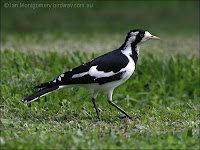
Magpie-lark

Cheekily scavenging round the Botanical Café, red wattlebirds were plentiful, along with handsome western magpies, an entirely white-backed race of Australian magpie. The surrounding lawns held strutting magpie-larks. It seemed that any black-and-white bird down under got the “magpie” label. These bold birds became my constant companions throughout the breadth of Australia, excepting Tasmania, which would also distinguish itself in other ways.

Thus far the bird identification had been easy – galahs, grey fantails, silvereyes and ravens included. Maned and black ducks, coots, a kookaburra with a rat-sized rodent in its bill, and a rainbow bee-eater would also be no serious challenge. For a beginning birdwatcher the Botanic Gardens are marvellous, holding a good but not overwhelming selection. However, for the purist, one bird was cryptic.

Sunday, 28 June 2009

Australian Field Guides

I had picked up Ken Simpson and Nicholas Day’s book, in its green-jacketed incarnation, on my 2003 visit to New South Wales. I loved it but, boy, was it bulky and heavy, even as a paperback. It carries sections you don't need in the field. I had used it and Graham Pizzey to research and plan the trip back in the UK and thought that, with Australia’s huge avifauna, no countrywide book could be compact enough.

Field guides also show their age, especially in a place as underwatched as Australia. Birds move around. So, I was looking for parrots in Perth and not finding them until I happened on rainbow lorikeets, whose distribution is east, north and south but definitely not west. They fitted the colour scheme, still swooping across the square in front of me – blue head, green upperparts, red under and blue vent. I couldn't turn these birds into female or juvenile plumages, even, of the expected western parrots.

Michael Morcombe solved the puzzle for me. I found his guide at the Botanic Gardens and it noted that some clown had introduced rainbow lorikeets to Perth. Moreover, the book fitted into my bag, didn't weigh a ton and had neat density maps. These show the likelihood of finding a species, from a faint wash for vagrant records up to a dark splodge covering the highest concentration. This works especially well for Australia, where birds don't migrate so much. Other field guides have to colour code for times of year.

So, the Morcombe became my bible and I was ready to tackle the rest of King’s Park, which surrounds the Botanics.

Sunday, 21 June 2009

Arrival at Perth, 2008

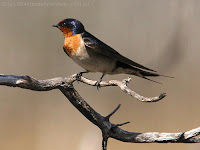
Welcome Swallow

Red.

That's the impression of Western Australia from the air, the very ground rusting away, contrasting with the Indian Ocean blue as our plane followed the coast down to Perth. Not a town to be seen for hundreds of kilometres until the grids of civilisation appeared within a boomerang-throw of the capital. Perth almost sneaks up on you in surprise and we were down and out of the terminal faster than Adam Gilchrist gets to a century.

I had booked the shuttle bus downtown, which rather surprised the driver, who was prepared to hang around until the last passenger had squeezed out of the airport. This gave me time to identify welcome swallows, so at least the birds were pleased to see me; and I had finally hit summer after a couple of dismal British washouts.

The bus bounced into the city, over the Swan River, home to silver gulls, and past the WACA, home to cricketers. The kid sitting in front of me clicked his camera phone at everything. He had flown from Britain in one and was hyper from lack of sleep. He snapped the cricket ground. He had no idea what it was – cute.

The remainder of the day only gave me time to eat but it was light enough, while I sought out a restaurant, to register parrots squawking and zipping between trees. They were too fast to identify but the calls were familiar; I just couldn't pin them down. A disappointing nasi goring preceded bed, perchance to sleep. Or not, as it happened.

Friday, 8 May 2009

Birding Australia, 2008-9

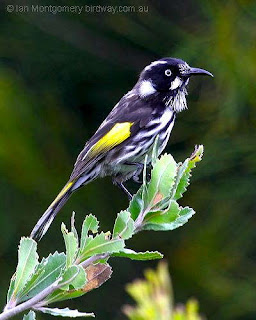
New Holland honeyeater

But first, and to be interspersed throughout these posts, the story of how my life list climbed from 850 to 1058 of the world's 10,000 species of bird. It took one trip, principally to Australia, which I had been promising myself since spending a mere week in the country, back in 2003. The landscapes and the birds had captivated me. I needed to see more of both.

The trip would never have happened but for the combination of a mental landlady and her psychopath son. I was homeless in Edinburgh, which is not a pretty prospect, and had to decamp to my mate’s house in Redditch. This seemed the perfect platform from which to launch Round-The-World Mark Two.

I needed a route. I never reckon on wandering aimlessly. Certainly, I wanted to take in Perth, and Queensland was a must. How to fill in the gap between? I also needed a quest, apart from generally boosting my life list. I settled on the 73 species of honeyeater, a very Australian family of birds. I would try to see most of them, which determined the route: southern West Australia; Adelaide to Cape York via the outback; and Tasmania. I figured only a definite couple of misses that way, and a couple of extremely unlikely birds.

I was set. Now I only had to buy the tickets, and pay for them.

 
Creative Commons License

This work by Andy Gibb is licensed under a Creative Commons Attribution-Non-Commercial-Share Alike 2.0 UK: England & Wales License. It also uses Google Analytics and so creates tracking cookies and collects non-identifiable data about you.